WRITTLE PARISH COUNCIL
History of Writtle Parish Council
Writtle Parish Council celebrates 125 years
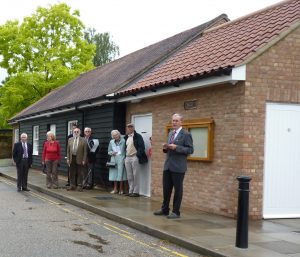
In April 2019 Writtle Parish Council celebrated its 125 th Anniversary. A plaque was unveiled by Lord Petre in the Parish Office recording all the names of past Chairmen. During the afternoon parishioners were able to meet the Parish Councillors and Writtle Archives put on displays with photographs of the work done by the Parish Council and the history of the village over the last 100 years.
A parish council is a civil local authority and is the first tier of local government . Parish councils are funded by levying a ‘precept’ collected from within the council tax paid by the residents of the parish. Parish councils are made up of unpaid councillors who are elected to serve for four years.
The First Writtle Parish Council
In 1894, on Tuesday 4 December, at 6pm, a Parish Meeting was called to elect a Parish Council for the Parish of Writtle. The Overseer for the Parish, Dr. Robert N Arnold Wallinger, had, in accordance with the instructions of the Local Government Board, called the meeting, and the Vicar of Writtle, the Rev T L Papillon proposed that the Chair should be taken by Mr T Usborne, MP. Mr Usborne conducted the ensuing election of eleven members to the Council, which was done by show of hands. Mr Uzziel Rust obtained 137 votes, and the others elected were Messrs W H L Pattisson, R N Arnold Wallinger, J Christy, J Caton, H Kennell, R R P Hilton, J Clark, B A Metson, J Pamplin and G Hitch. Eighteen candidates had stood for election, and the Vicar had come, sixteenth in the poll, but at the first meeting of the Council on 13 December, he was elected, without opposition, to be Chairman of the Council. No member of the Council was willing to act as Clerk, and so Mr C J Dennison, the Assistant Overseer for the Parish, became the first Parish Clerk. The first minute book for the years 1894 to 1909, written throughout in Mr Dennison’s hand, along with the more recent minutes books are now stored at the Essex Record Office for safe keeping.
The Parish in those days was considerably larger in area than at present and had been one of the largest in the county though some years previously a portion had been detached to form part of the Parish of St. James, Chignal. At this time it incorporated areas subsequently included in the Borough of Chelmsford, namely the Waterhouse Estate (including the area from the present town boundary to the railway line) and the Chignal Road estates. It also incorporated the whole of the present parish of Highwood, and small portions of Ingatestone and Margaretting parishes. Many of the entries in the minute book relate to the growth of the Waterhouse Estate, first by the development of the Crompton works and then by the spread of housing, until in 1907 it was, not without much opposition from Writtle and the Chelmsford Rural District, incorporated into the Borough of Chelmsford.
Many of the concerns of the Parish Council still remain. The Green was a real concern, as was the Wear Pond, and in those days as today, trouble was taken to keep them in good condition. Trees were planted and chains placed round the pond, and the pond itself kept clean, whenever necessary. The village in 1894 still lacked many of the amenities we now take for granted. There was no piped water or sewerage, and the approach of these was eagerly awaited. Street lighting was also slow in coming to the village, and the lamps were few and far between. No fire service existed in the village, and from time to time the Council enquired about the use of engines from Chelmsford but on one occasion found it too expensive. The Council met for many years in the lron Room belonging to the Parish Church, or occasionally in the Girls’ or Boys’ old Schools. Earlier suggestions by the Trustees of the Attwood Charity that a Library and institute should be provided out of its funds was eventually agreed, and a new Village Hall was built from the money. The last entry in the first minute book records the first meeting in the new Attwood Village Hall, where they were to meet for over fifty years. The meetings were much shorter than now and the money expended very small by the standards of today.
In 2012 on a site in the car park near the pond a new specially designed Parish Office was built and opened by Baroness Platt. This project was funded by Maztec the organisers of the V Festival.